Below is our finished music video

My Outside Digipak Panels

My Outside Digipak Panels

My Inside Digipak Panels

My Inside Digipak Panels

Please click the image below to view our finished website

Monday, 13 March 2017

Construction Post 24: Reflections on Edit Week 1

Our groups target for this edit week was to have all our chosen shots onto the editing timeline in the correct order and cut down to the correct length. We also aimed for them all to be edited for proper continuity and mixed well with the soundtrack and sound effects. As well as all this we wanted our titles to all be in the correct positions but with basic effects, i.e. not done on LiveType. The reasoning behind this was because we needed to find out if any of our shots needed to be redone for reasons such as incorrect framing, bad lighting or acting which could be improved upon. Any shots which we thought needed to be re shot were noted and then planned as part of the back-up shoot on the following weekend. To make sure the group's organisation was high we designed at edit schedule so everyone knew when to be editing and to ensure the workload was fair.

Our edit schedule
There were two main issues which we flagged up that we felt took precedence over the rest:

1) Throughout the entire news reporter scene, the actor can be clearly seen looking to the left of the screen in order to read her lines; this is not normal for a professional news broadcast and therefore disrupted the immersion of the audience. Thus, we agreed that the actor needed to learn her lines in advance so this issue would not arise again in the back-up shoot.


2) Another issue we encountered when looking back on our footage was that is was not obvious for the audience that the antagonist was watching the news broadcast due to some continuity errors. To fix this we thought it was best to add some reaction shots of the antagonist during the broadcast as this would make it clear to the audience that he was watching it.

In spite of these issues which needed to be corrected, I believe that this edit went very well due to the high efficiency that everyone in the group worked at as well as the fact that we felt our sequence was meeting the demands of the brief.

Construction Post 23: Our Post-production Kit

Our post production kit consisted of two different types of equipment, hardware and software.

Editing Hardware:

Dual monitor computer                                                                    MacBook                             

This is the PC on which we used Adobe Premiere Pro

This is where we used LiveType on

Headphones                                  

These were connected to the Computer


Editing Software:

Adobe Premiere Pro      
                              
This is where we did all of our editing


  LiveType

This is where we made our titles

Construction Post 22: Reflections on our Main Shoot Session

I think our main shoot was very effective and useful as it showed us any last problems we need to correct before we finished editing. From this reflection we made a revised shoot board, of which shots which we wanted to re-do could be found on. This shoot board would be for the back-up shoot we decided to schedule on the following weekend.


Construction Post 21: Our Production Kit

When it came to taking out our kit for the shoots we were given an in-depth tutorial on how to use the equipment by the technician. She informed us on how to use what we were given safely and efficiently. To confirm that we had taken out the equipment we signed an 'Equipment Release form' which represented us taking responsibility for it.

The kit that we had asked for
Our 'Equipment Release form'


Key Equipment:

Canon Legria HF G30 Camera


This camera was small, easy to use and portable. This made it very helpful when we needed to switch from standard tripod shots to hand held action shots. Also it made positioning the camera in our set-pieces much easier and therefore help us keep to schedule with high efficiency. 

  
Canon DM-100 Directional Microphone


The microphones quality really stood up during times in which the weather was not perfect. For example, its ability to pick up dialogue to a high standard enabled us to still capture good quality footage in the windy conditions.


Libec TH-650 HD Tripod


The tripods retractable legs and light frame enabled our outdoor shots to be completed with high efficiency as we could easily transfer between shot types whilst also allow us to make alternative shot, i.e. different heights, with more ease.


Wednesday, 1 February 2017

R+P Post 20: Reflections so far/looking ahead

My group and I recorded our reflections on the how we felt the test shoot went in the form of a podcast. This be be accessed below:

R+P Post 19: Our rough cut

For our rough cut we had to edit all week but each member of the group was given specific time allocations in which they had to edit alone as we did not always have the same periods in which we were free in order to edit as a group.

Our rough cut editing schedule
After everyone had finished editing we came together as a group to watch through our rough cut video to get rid of any more underlying issues which we could sort out, such as unbalanced audio, and then to make notes of any issues which could only be sorted out on another shoot day, such as continuity errors.


Once we had found every issue we wanted to correct, we made a list of revisions which we would take on board when adapting the storyboard, shoot boards and timeline; thus allowing our main shoot day to consist of everything we needed top ensure we fulfilled all of our revisions. Moreover, we also showed our final rough cut video to our teachers who gave us feedback, from which we took some ideas on board to help make our sequence better; we also had the technician watch though it to ensure any technical issues could be resolved or at least found so we could work on them.

Our group's revisions
Our teachers feedback

R+P Post 18: Our test shoot

The purpose of the test shoot was to to find any issues in our planning or our overall idea which we could then resolve before our main shoot as after this it would be much harder to film any more shots within time restrictions. Some of the planning tools we used which had to be adapted included, the shoot board and the storyboard.

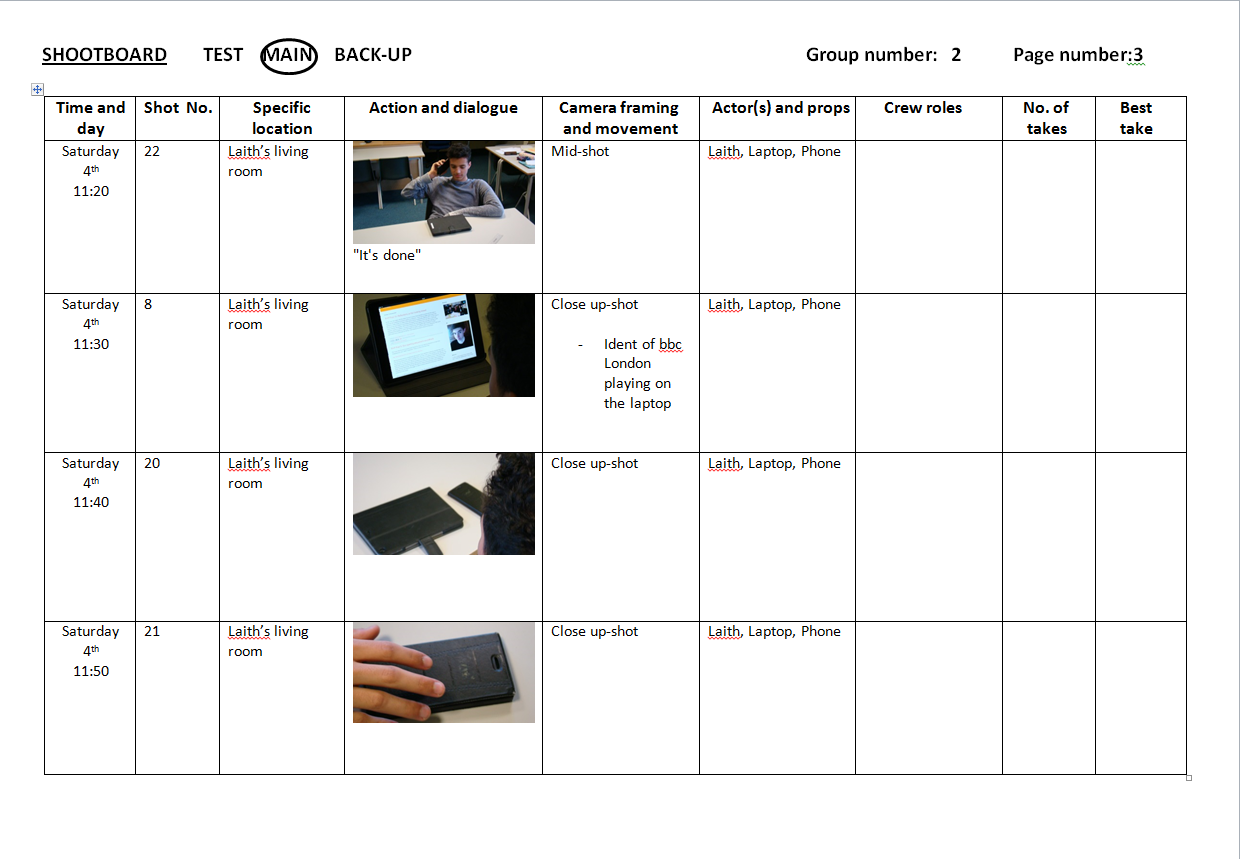
This is a sample of our shoot board
After editing our test shoot footage we encountered some issues such as a lack of purpose for the antagonist, Damien Brooks, as it was not obvious to a viewer if he was actually watching the news broadcast due to the shots we used on the shoot board. For example, we changed shot 8 on the storyboard to a close-up (as seen on the sample page to the left) as this would make the transition from the camera filming the laptop screen to a full screen of the news anchor more seamless and in turn make the audience know that this is what the antagonist is doing.


For our storyboard we had to add extra shots, such as reactions shots of the antagonist watching the news broadcast as this would make his purpose in the sequence more obvious to the audience and in turn make the resulting phone call make more sense. Some of these reaction shots included a shot of the antagonist becoming relaxed and happy when the news reporter is attacked, thus implying he is behind the attack or at least an accomplice in it; this would make the audience feel anxious and fear due to their nature of feeling remorse when someone is attacked and that in contrast this man is rejoicing in it.

When looking back on our footage I was happy with our continuity sequence towards the beginning as all the shots seemed to flow and link together well, thus making the characters movement though the house more realistic. An short clip of continuity in our sequence can be seen below.


This shot achieved all the goals we set out for it as it not only had good continuity, it also had the dim lighting we were striving for to help make the antagonist seem creepy and thus provide a gritty feel to the sequence.

However, an example of some bad shots in our sequence would be when the news anchor is listening to the news reporter speak. His reactions do not always link with the words or action of the news reporter, whilst there is a notably short time between their dialogue at one point; this in particular is very unlike an actual news report as there is usually a longer gap between speech.